 DialogSkills
Conversation training for learning and development.
Courses, exercises and conversations with AI clients that respond, for employees, new starters, managers and professionals. Participants practise the conversations they actually face, between workshops and whenever it suits them, and get feedback after every conversation.
In use today: MI-lab · EFT-lab · Lederlab · Inkluderingslab
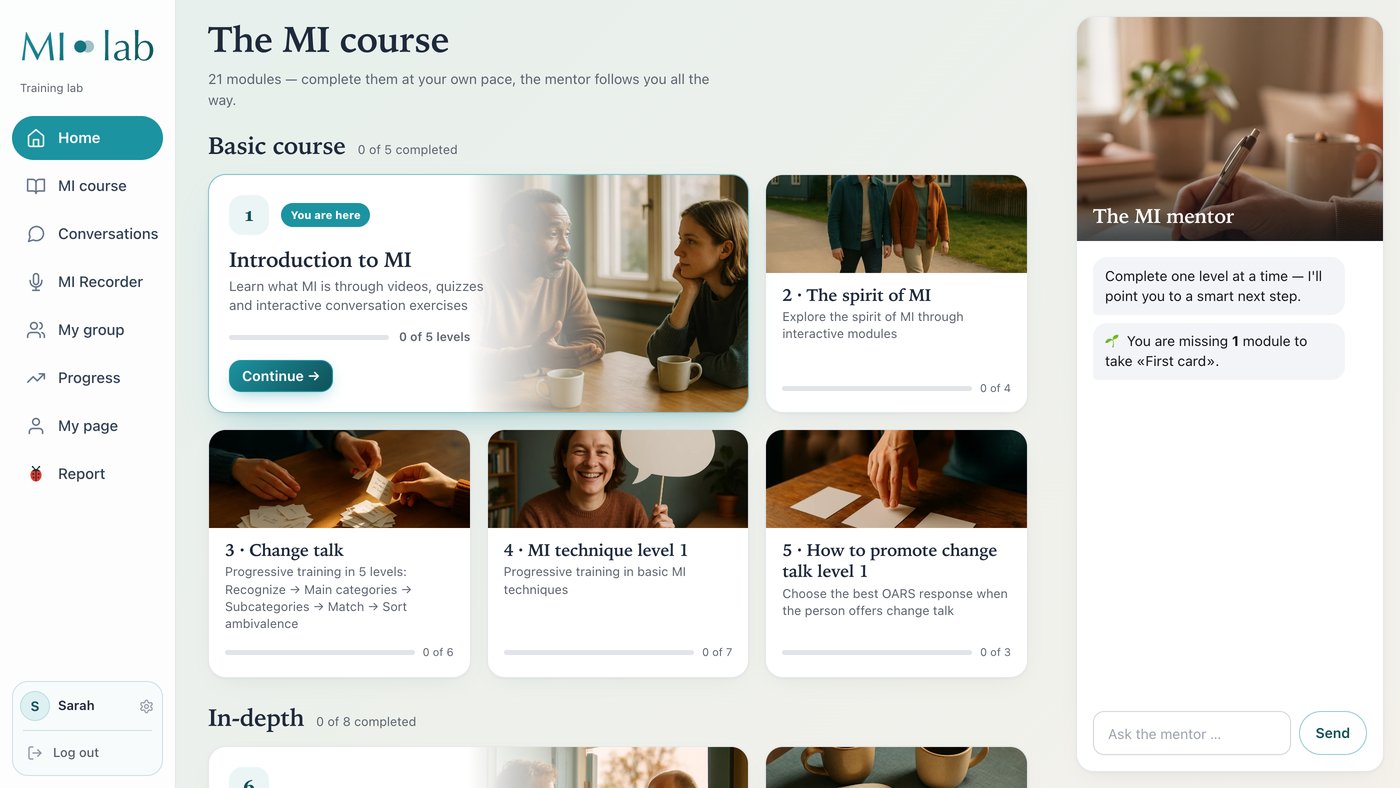
Training in the conversations the job is made of.
Most jobs have conversations that decide the outcome. We build training for them, whether you are onboarding new staff, keeping a professional standard alive or developing a whole team.
Employees and new starters
Staff practise the everyday and the difficult conversations before they meet them on the job, at their own pace and with the same content for everyone.
Professional standards and methods
When your organisation works to a specific method, we build the training on it. For example employment specialists working with IPS, or counsellors and health professionals using motivational interviewing.
Customer conversations and sales
The sale, the complaint and the customer who is angry or unsure. Customer conversations →
Therapists and clinical communities
A lab for your therapeutic approach, built with the community that owns the method. EFT-lab is the first. For therapists →
Managers
The appraisal, sickness absence and the warning, in Lederlab or a leadership lab of your own. For managers →
Your own conversations
If none of our labs covers your conversations, we build a lab around them. Your own lab →
Practice between the workshops.
A course gives knowledge. Skill comes from practice, and that rarely happens in the classroom. The lab gives participants a place to keep practising.
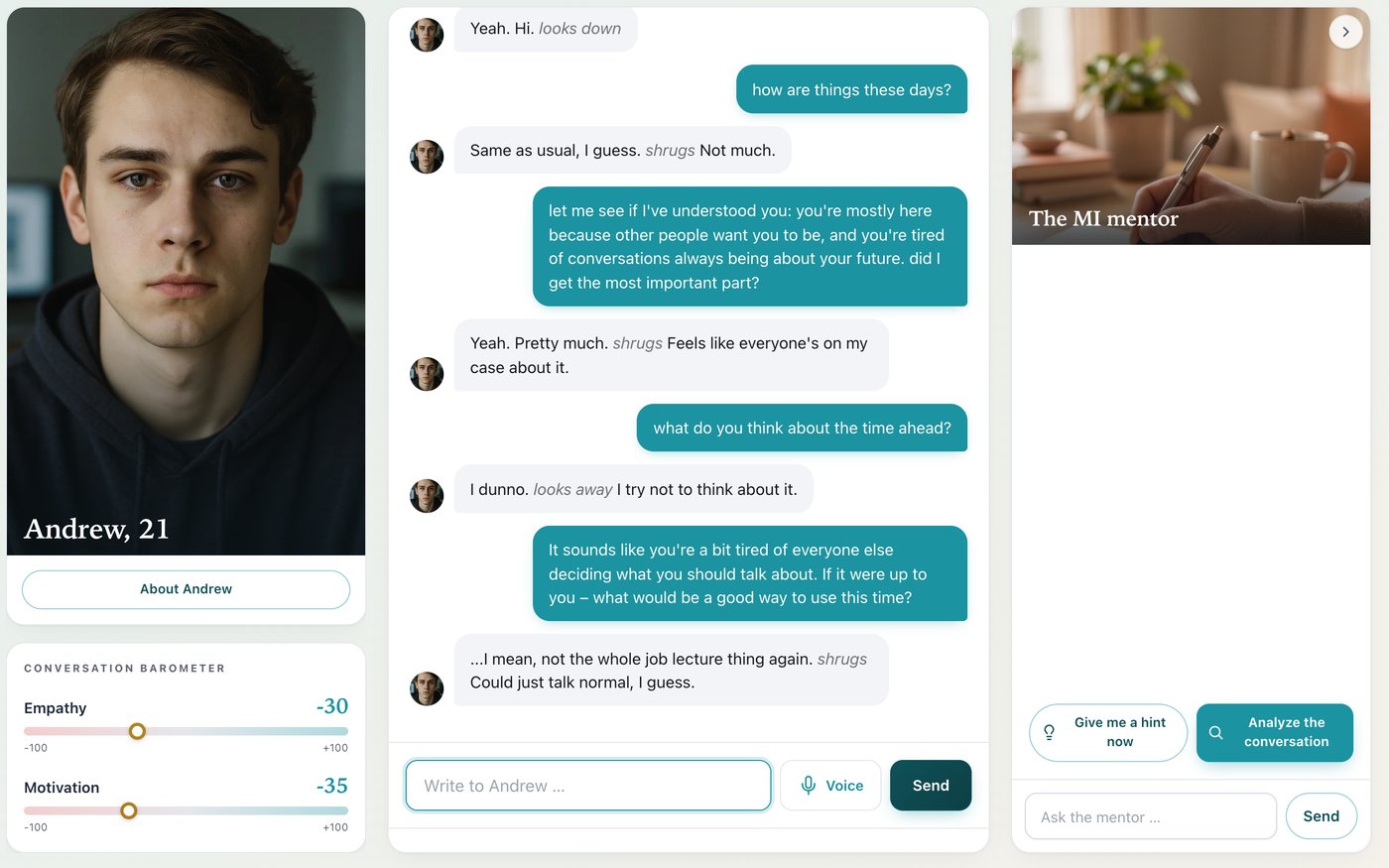
MI-lab
- Between workshops and courses. Participants practise what they learnt in the weeks after a session, and arrive better prepared for the next.
- Short sessions. An exercise or a conversation takes a few minutes and fits around the working day, with no classroom or actor needed.
- Cases from everyday work. Clients and cases are built on situations participants recognise. In MI-lab, participants can also create their own case.
- Type or speak. The clients respond to what the participant actually says, in text or by voice.
Tools for the trainer in the room.
The lab is not only for practice between workshops. We also build tools the trainer uses during the course itself, and can adapt them to your training.
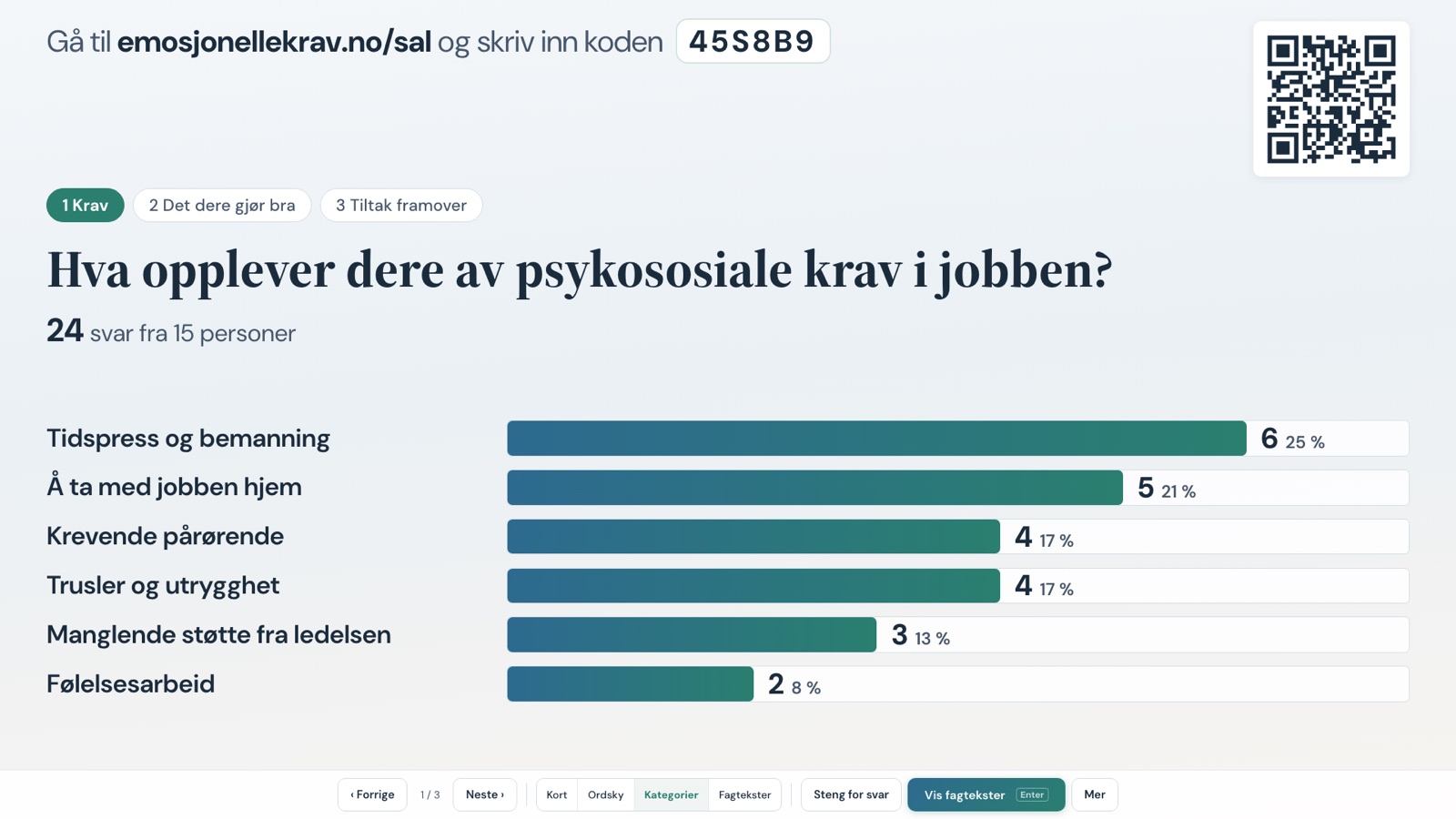
Questions for the room, from a demo on emosjonellekrav.no (in Norwegian)
- Plenary mode in the lab. The trainer shows an exercise from the lab on the screen, with a code and QR code. Participants answer anonymously on their phones, without signing in. The room sees how the answers are distributed, then the correct answer and the reasoning. In use in EFT-lab.
- Recorder for role plays and exercises. Participants record the role play on their phones, and the recording is transcribed and analysed against criteria for the field and the type of conversation the trainer has chosen. The trainer creates a code or QR code for the course, and participants need no account. The analysis can only be opened on the phone that made the recording. In use on MI and leadership courses.
- Questions for the room. Multiple choice, scales, ranking, free text and quizzes, plus questions from the audience that others can vote up. AI groups the free-text answers into categories, and participants can get a summary on their phones afterwards. In use on emosjonellekrav.no (in Norwegian), for talks and workshops on emotional demands at work.
- Made for your course. If your training needs something these tools do not cover, we can build it.
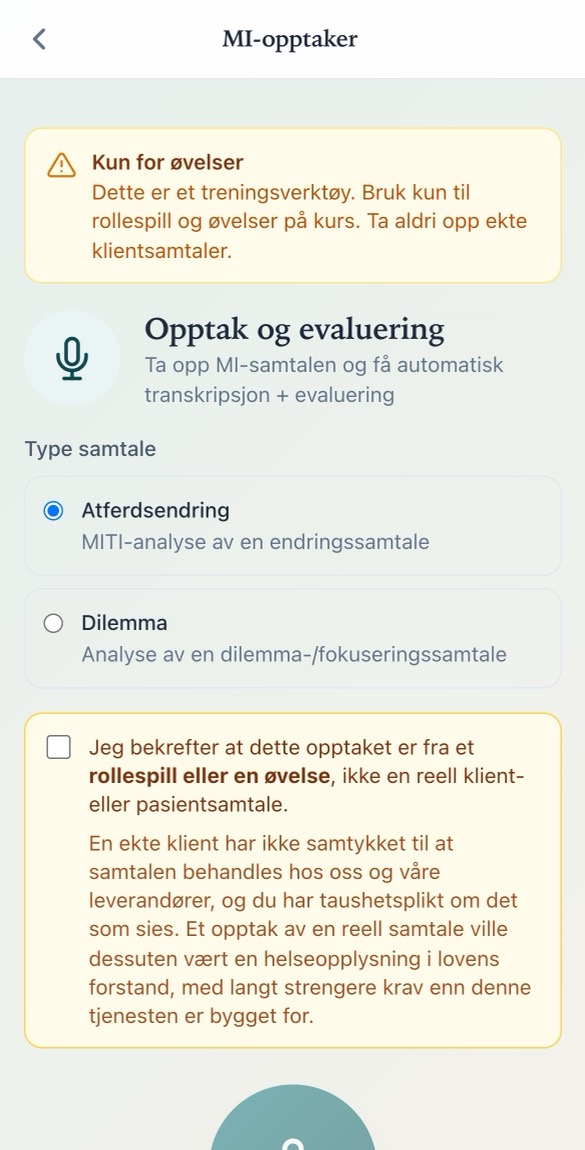
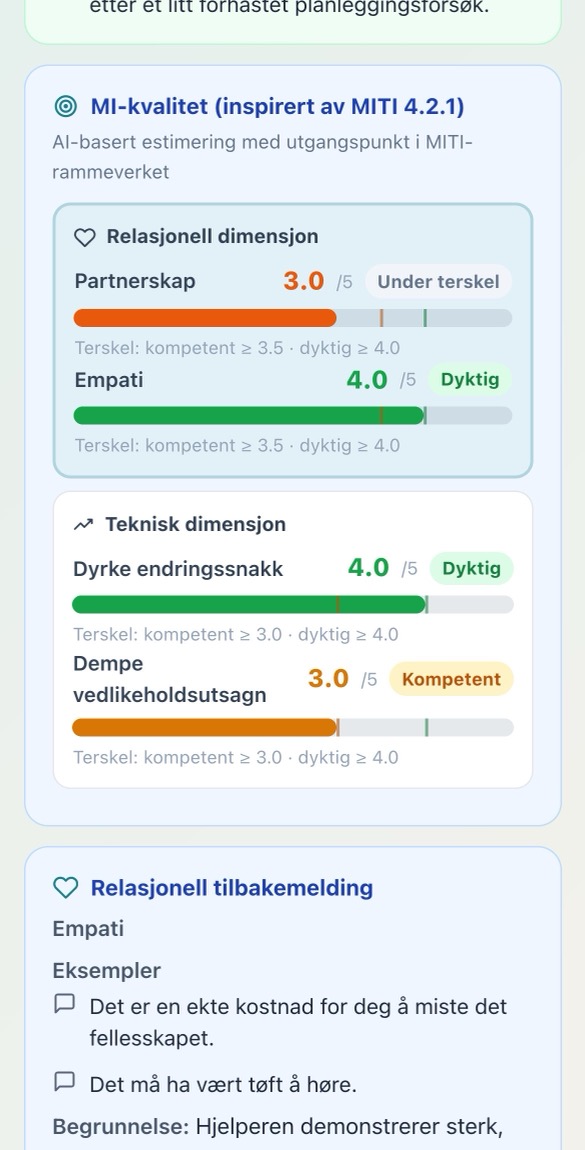
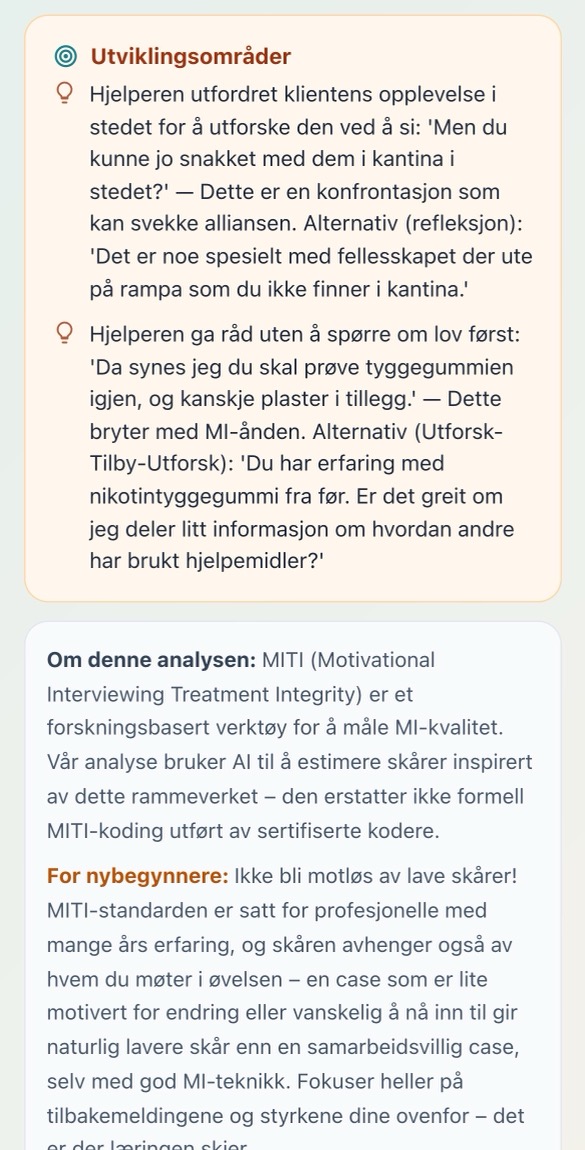
The recorder in MI-lab as participants see it on their phones, shown in Norwegian. The role play was written for this example.
What you can see today.
We only describe what the platform does now. We have not yet carried out impact studies of the labs.
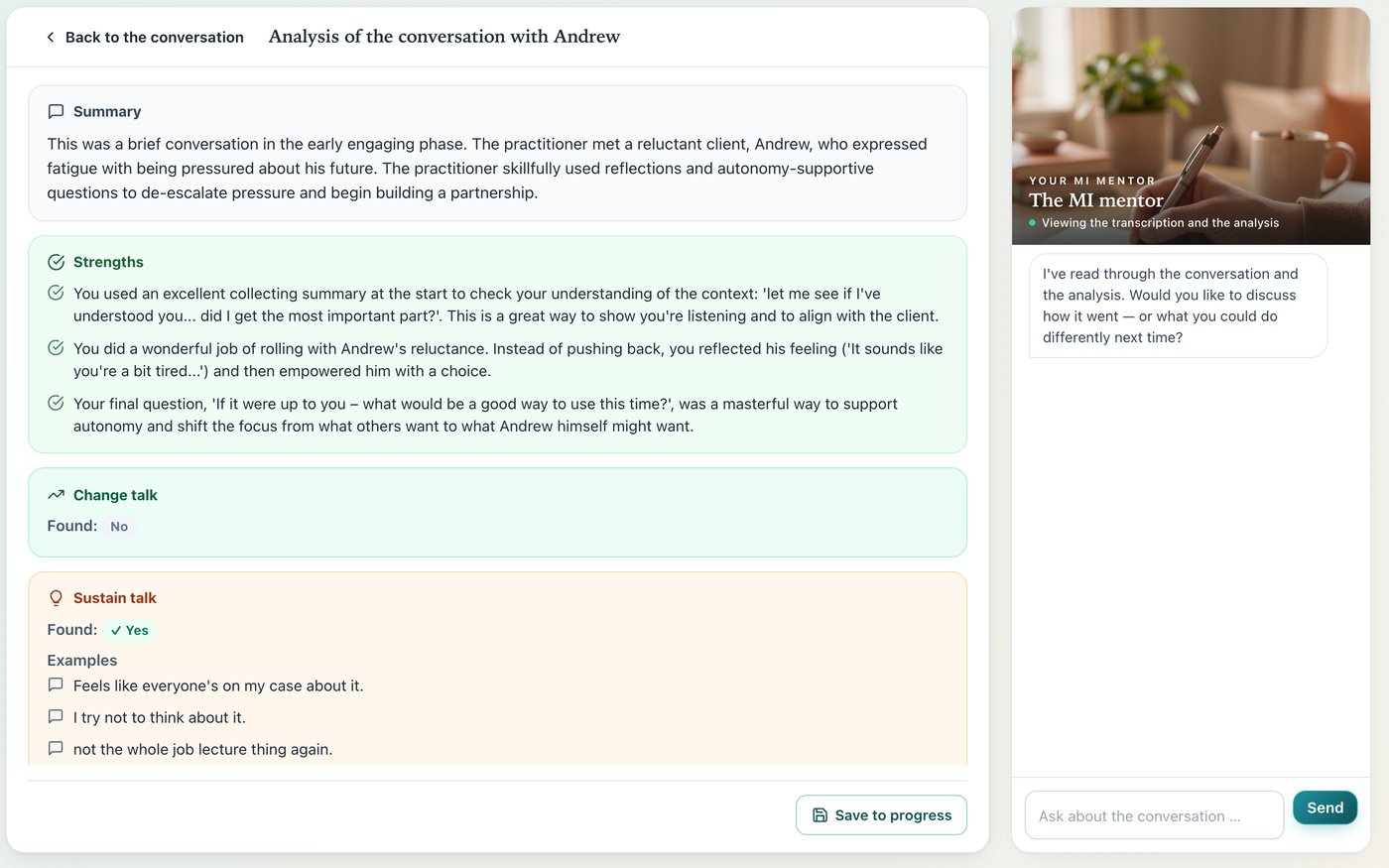
MI-lab
- Analysis after every conversation. Participants see what they did well, what the client said and what could be done differently, based on the field’s own criteria.
- Progress for each participant. Courses in a set order, and participants see how far they have come.
- An overview for the organisation. In MI-lab, the administrator sees how far each participant has come and how much the service is used. Not what anyone has written or said.
Training plans for a whole term are in development. See the sketch →
Start with one group, then grow.
Pilot first
Many start with one group, try the lab for a period and decide afterwards.
A lab for your organisation
A ready-made lab in your branding, or a lab built around your method. Both with your own users and an overview for whoever leads the training.
Priced per user
The price follows the number of users. We give a quote after a conversation about what you need.
Your experts own the content
Your professionals make sure courses, clients and feedback follow the method you use.
Progress, not access.
The first thing employees often ask: can my manager read what I wrote? In MI-lab, the answer is no. What follows applies to MI-lab and EFT-lab, which each have their own privacy policy.
Managers see progress, not conversations
In MI-lab, the administrator sees how far each participant has come and how much the service is used. No other user can open the conversations, analyses or cases someone has written.
Stored in the EU, with agreements in place
Data is stored on servers in Germany. We have data processing agreements with our suppliers, and the content is not used to train AI models. Client replies are generated by language models from OpenAI in the US, covered by the EU standard contractual clauses.
Fictional clients
Participants practise with AI-generated clients, not real people. The lab must not be used with information about real customers, users or patients.
Deleted when no longer needed
In MI-lab, training data is deleted 12 months after the last activity, and 90 days after an agreement with the organisation ends. DialogSkills AS is the data controller.
Privacy on this website →MI-lab: privacy policy →EFT-lab: privacy policy →
Can managers read what employees write?
No. In MI-lab, the administrator sees how far each participant has come and how much the service is used, but not the content of the conversations, the analyses or cases they have written themselves.
Can staff sign in with their work account (SSO)?
Get in touch, and we will find out what suits you.
Can the lab connect to our LMS?
Get in touch, and we will look at what you use and what is possible.
How much time do participants need?
That is up to you. An exercise or a conversation takes a few minutes, and many use the lab in short sessions between workshops and courses.
Which languages?
MI-lab is available in English, Swedish and Norwegian. Our other labs are in Norwegian today. A lab of your own can be built in English.
What does it cost?
The price follows the number of users. We give a quote after a conversation about what you need.
Are the clients real people?
No. The clients are fictional and generated by AI within limits set by professionals.

Tell us who needs training.
Stian Midtgård is a psychologist licensed in Norway, working in work and organisational psychology, with more than 20 years’ experience of communication skills training for managers and frontline professionals. He built the platform.