Illustration in NorwegianCustomer lab
- The customer who has a cheaper offer
- The complaint about a wrong delivery
- “Too expensive” and other objections
- The customer thinking of switching supplier
Fictional example with a made-up company.
Courses, exercises and conversations with people who react to what you say, built around the conversations that matter and are difficult for you. With your name, logo and colours.
In use today: MI-lab · EFT-lab · Lederlab · Markedslab
Our labs in use today are in Norwegian, and MI-lab is also in English and Swedish. A lab of your own can be built in English. The examples on this page are in Norwegian.

The screenshots are from our Norwegian labs and from fictional examples.

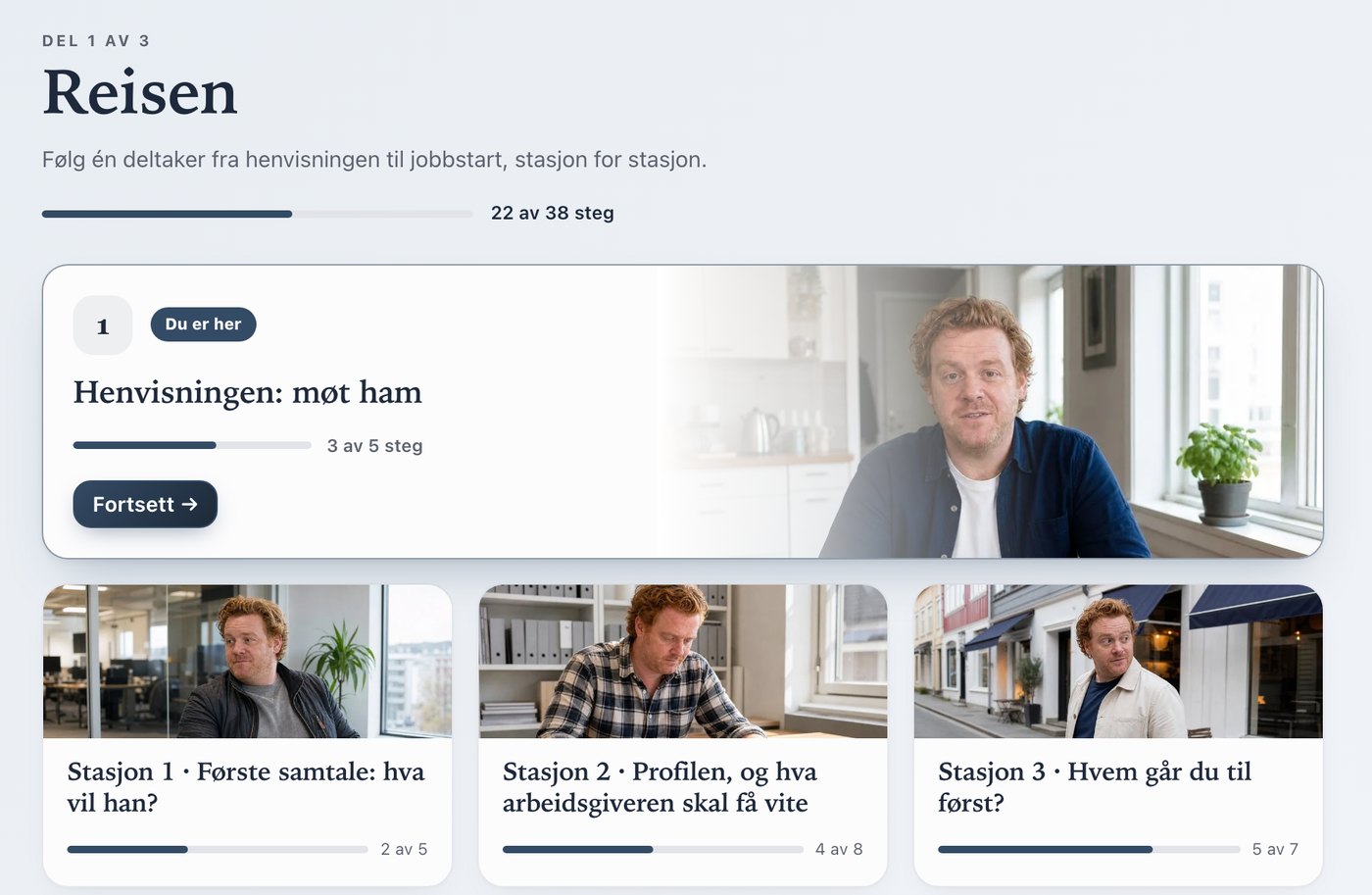
Markedslab · in Norwegian
Modules that build on each other, with short videos, theory and tasks. Employees see how far they have come and what comes next.

Lederlab · in Norwegian
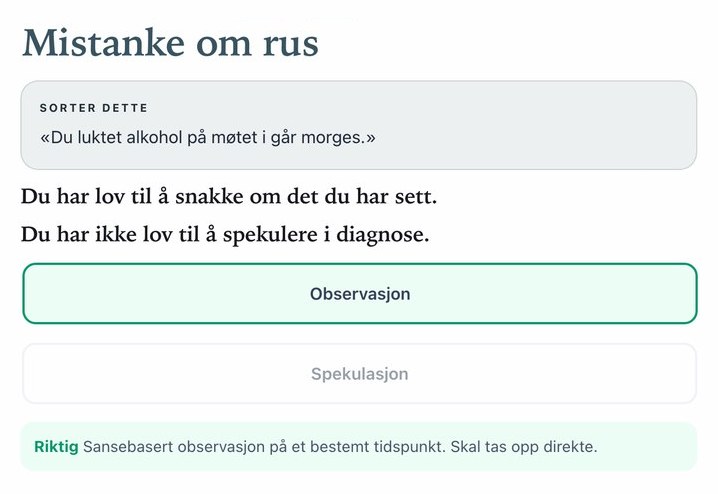
Short, concrete text tied to the conversations you will practise. The exercises train one technique at a time: recognising it, choosing it and phrasing it yourself, with an explanation after each answer.

Fictional example · shop chain · Illustration in Norwegian
Customers, employees or service users with a history and reactions of their own, who respond to what the employee actually says, in text or by voice. The employee can try again and see what changed.
The people are fictional and created for the situations in your organisation.

Lederlab · in Norwegian
After the conversation the employee gets an analysis: what they did well, how the conversation developed and what they can try next time. An AI mentor answers questions along the way.

Kvistlia Foreldrelab · Fictional example · Illustration in Norwegian
The employee describes a situation from their own working day, and the lab creates a realistic person to practise with. That way you can rehearse the conversation you are dreading tomorrow.

Markedslab · sample data · in Norwegian
The manager sees how the team answered in an exercise, without names and without individual grades, and gets questions to raise at the team meeting.
The sketch shows how it will work. The training plans and the AI assistant are being built now.
Whoever leads the training sets goals for a term, with short sessions every week. That way employees keep practising long after the course has ended.
A certificate when the plan is complete.
The manager sees the team’s status and who has completed the plan. Never what an individual has done, answered or received as feedback.
Each lab gets the organisation’s name, logo and colours. Some of the labs below are in use today; others are examples with fictional organisations, showing how a lab for you could look. The screenshots are in Norwegian.
Illustration in NorwegianFictional example with a made-up company.
Norwegian versionIn use today with NAV, health services and employment services in Norway. Also in English and Swedish.
In NorwegianFrom Lederlab, in use today. Norwegian only, built on Norwegian employment law.
In NorwegianFrom Markedslab, for Norwegian employment services, such as IPS (Individual Placement and Support) and AFT (work preparation). Variants are in use with employment services.
Illustration in NorwegianFictional example with made-up nurseries.
Schools, local authorities, banks or something else entirely. We build the lab around what is difficult for you.
Talk to Stian →Swipe for more examples →
We create the lab together with your experts and managers, from the first meeting until it is in use every week.
TogetherWhich conversations matter most and are hardest for you, and what good practice looks like.
YouCourses, people to practise with and feedback build on your methods, and your experts approve the content.
Us, with your staffWe create the lab, some of your staff try it, and we adjust until it hits the mark.
In everyday workThe lab goes into use, and we keep developing it as you learn.
No. In MI-lab, the administrator sees how far each participant has come and how much the service is used, but not the content of the conversations, the analyses or cases they have written themselves. Data is stored in Germany, and the content is not used to train AI models. Privacy →
Yes. A lab of your own can be built in English or another language. The content, the exercises and the people you practise with must then be checked by someone who knows both your field and the language. MI-lab is already available in English, Swedish and Norwegian; our other labs are in Norwegian today.
We give a quote after a conversation about what you need.
A professional who knows your conversations, a few hours for mapping and reading through, and a few employees who test the lab before it goes into use.
Yes. MI-lab, EFT-lab and Lederlab can be used with your branding and your own users. MI-lab is available in English; EFT-lab and Lederlab are in Norwegian. See the labs →
It depends on the scope and what you want. We start with a conversation to understand your needs, and then you get a plan with a timeline and a price.
Material and cases based on your day-to-day work are yours, even when we write them for you. We do not use them with other customers. DialogSkills owns the platform, the simulation engine and the way we build the clients, and you can use the general cases from our ready-made labs for as long as the agreement runs. If you leave, you can have your own content handed over.
No. They are fictional and created by AI within frameworks set by professionals. The lab must never be used with information about real customers, service users or patients.

Stian Midtgård is a psychologist working with organisations and leadership, with more than 20 years’ experience of communication skills training for managers and frontline professionals. He built the platform.
We would like to use Google Analytics to see how the site is used. It sets cookies. Read more (in Norwegian)