Lederlab has modules for the difficult conversations and the everyday ones, employees who react to what the manager actually says, a leadership mentor and an analysis after every conversation. Norwegian organisations can use it as it is, or get a leadership lab of their own with their name, colours and cases.
Lederlab is available in Norwegian only. It is built on Norwegian employment law and Norwegian guidance from STAMI, the Labour Inspection Authority and NAV. A version for another country has to be built on that country’s law and guidance, together with a local professional.
Lederlab, in Norwegian · the home page with the three levels and the mentor
20 modulesfrom difficult feedback to dismissal
25 employeeseach with their own story and their own workplace
3 levelseveryday, strategic and serious legal conversations
Text or speechthe manager types or speaks
What managers practise
The difficult, the everyday and the important.
Each module has its own employees, its own theory and its own exercises. The modules are grouped into the same three levels the manager finds in the lab.
Everyday leadership conversationsConcern about mental health
Everyday leadership conversationsSetting expectations and goals
Strategic leadership conversationsThe appraisal
Everyday leadership conversationsOnboarding: the 30/60/90 conversation
Illustrative photos. The people shown are models and have no connection to the conversations described.
Everyday leadership conversations
One-to-ones where the relationship is at stake
Giving difficult feedback
Suspected substance misuse
Setting expectations and goals
Signs of burnout
Concern about mental health
Navigating resistance
Sickness absence and return to work, including Norway’s statutory dialogue meeting
Onboarding: the 30/60/90 conversation
Delegation
Life events: grief, illness and divorce
The senior conversation
Strategic leadership conversations
Conversations that shape direction, motivation and career
The appraisal
The pay conversation
Career development
Serious legal conversations
Duty to investigate, employment law and high legal risk
Formal written warning
Dismissal on personal grounds
Redundancy
Whistleblowing and suspected harassment
Fact-finding investigation
Conflict between employees
A training tool, not legal advice. Real cases are handled with HR and a lawyer. The legal content follows Norwegian law.
The content builds on established methods and theories of motivation, change and difficult conversations, including motivational interviewing and self-determination theory, and on guidance from STAMI (the National Institute of Occupational Health in Norway), the Norwegian Labour Inspection Authority and NAV (the Norwegian Labour and Welfare Administration). The legal references have been reviewed against the Norwegian statutes.
How you practise
Different conversations are practised differently.
A pay conversation, a welfare conversation and a dialogue meeting do not ask the same of a manager. That is why the modules are practised in three ways, depending on what makes the conversation difficult. The screenshots are from the Norwegian Lederlab.
In Norwegian
Track 1
Repeated practice
The skill has to stick. Little reading, many rounds.
Short theory
Recognising good and poor responses
Rewriting lines with a coach, round after round
Preparing your own conversation and practising it
Navigating resistance · Per
In Norwegian
Track 2
Try first
The hard part is daring to speak and coping with the reaction, not knowing the theory.
A first conversation before the manager has read anything
Theory about what happens in conversations like this
Rewriting the opening
The same conversation again, and reflection on what changed
Suspected substance misuse · Tora
In Norwegian
Track 3
Cases and decisions
The wrong order can have legal consequences.
Theory with references to Norwegian law
Putting the steps in the right order
Preparing the meeting
Practising only the part that is an ordinary conversation
Sickness absence
Swipe to see all three
How the manager practises
Employees who react, and help along the way.
Lederlab, in Norwegian · Practice conversation with Lise
01
An employee who responds
The manager types or speaks, and the employee responds to what is actually said. At first Lise says things are fine. When the manager names what she has noticed, Lise says what would help. Along the way the manager can ask for a hint.
The employees are fictional.
Lederlab, in Norwegian · About Tom
02
The workplace as the manager sees it
Each of the 25 employees has their own story and their own workplace. Before the conversation, the manager is shown what a manager would have seen: Tom has become quieter, is curt in meetings and pauses for a long time before answering.
Lederlab, in Norwegian · Suspected substance misuse, rewriting the opening
03
Rewrite, with a coach
The manager is given a line that does not work, and rewrites it. Here it is the opening “Tora, I’m worried that you’ve started drinking”. The task is to say what she has seen and why the conversation is happening, and to invite Tora in.
A coach gives feedback on each attempt.
Lederlab, in Norwegian · Analysis of the conversation with Lise
04
Analysis and leadership mentor
After the conversation the manager gets an analysis: the overall impression, what she did well, how the conversation developed and how she led it. The leadership mentor has read the conversation and the analysis, and answers questions about what she could do differently next time.
The mentor has its own knowledge base, including Norway’s Inclusive Working Life Agreement 2025–2028.
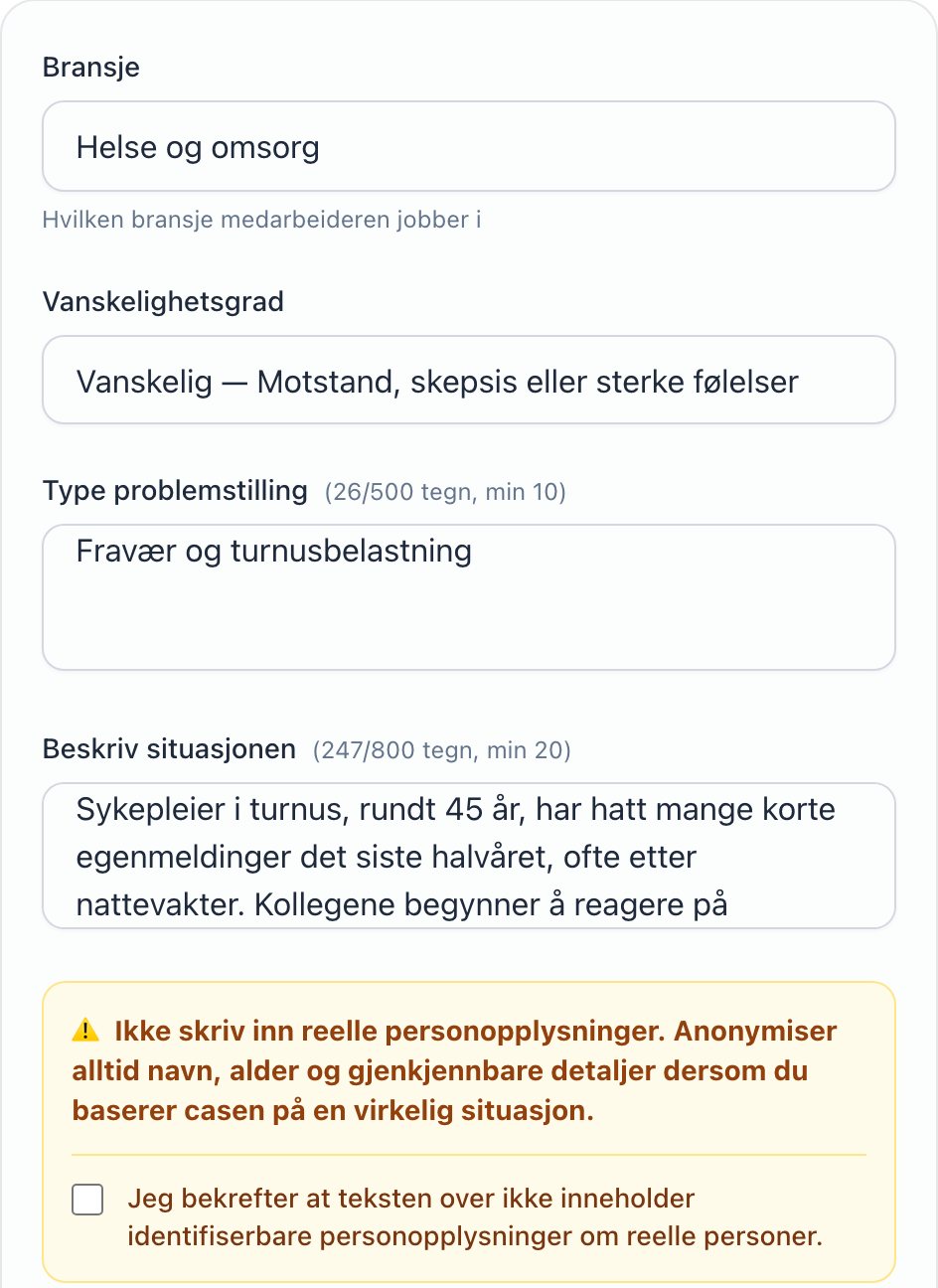
Lederlab, in Norwegian · Practise your own situation (fictional example)
05
Practise your own situation
The manager describes a situation from their own working day, chooses the sector, the level of difficulty and the type of issue, and gets an employee to practise the conversation with.
The form reminds the manager not to enter information about real people.
A leadership lab of your own
Your managers, your conversations.
The lab can have your organisation’s name, logo and colours, and content built around what is difficult for you.
Fictional example · Tindvik kommune · Illustration in Norwegian
What we can adapt
Name, logo and colours
Cases and employees from your everyday work and your sector
Variants for your sector, so the situations resemble your workplace
Policies and procedures from your staff handbook in the content
Your own users and a progress overview for whoever leads the training
Outside Norway, the legal content has to be built on your country’s law and guidance, together with a local professional.
Line managers at every level, and HR teams who want to give managers practice in the difficult conversations between leadership courses.
Can we use Lederlab outside Norway?
Not as it is. Lederlab is in Norwegian and built on Norwegian employment law and guidance. A version for another country has to be built on that country’s law and guidance, together with a local professional.
What does it cost?
We give a quote after a conversation about what you need, whether you want to use Lederlab as it is or have your own.
Can managers speak instead of typing?
Yes. The conversations with employees can be held in text or by voice.
What do we need to contribute for our own leadership lab?
Someone from HR who knows your conversations, a few hours for mapping and reading through, and a few managers who test the lab before it goes into use.
Are the employees real people?
No. The employees are fictional and created by AI within frameworks set by professionals. The lab must never be used with information about real employees.
Photo: Cecilie Bannow
Contact
Tell us which conversations your managers face.
Stian Midtgård is a psychologist working with organisations and leadership, with more than 20 years’ experience of communication skills training for managers and frontline professionals. He built the platform.
 DialogSkills