Illustration in NorwegianCognitive behavioural therapy
- Socratic dialogue: the client discovers it for themselves.
- Automatic thoughts: catching the hot thought.
- Case formulation: a shared model.
- Behavioural experiment: testing a belief.
We have built EFT-lab, and it is the template. We bring your approach into the same platform, and you get a lab of your own, built together with the clinicians who own the method.
EFT-labCBT-labMBT-labISTDP-lab

EFT-lab is available in Norwegian today. It was developed by Jan Reidar Stiegler, specialist in clinical adult psychology, in collaboration with the Norwegian Institute for Emotion-Focused Therapy and IPR (Institutt for psykologisk rådgivning). An English lab is being built together with practitioners in the field.
EFT-lab is the template. A CBT, MBT or ISTDP lab gets the same building blocks, with the approach’s own interventions, markers and clients. The screenshots below are from the Norwegian EFT-lab.

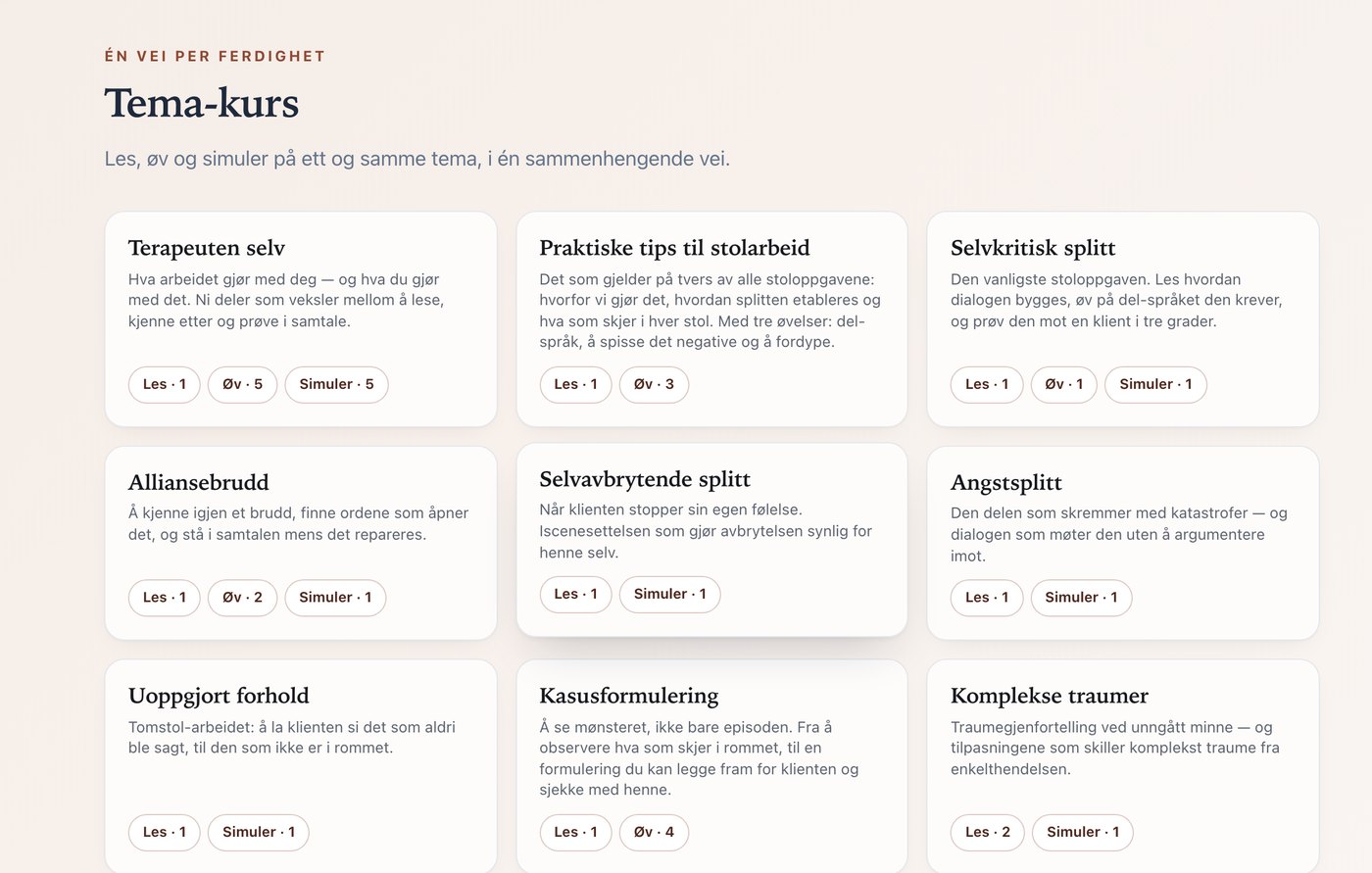
A topic course brings everything about one intervention together in a single sequence: the theory, exercises on the component skills, and a simulation where you try it out. The theory covers markers, steps, pitfalls and contraindications, and it is written together with the trainers and clinicians who own the method.
In EFT-lab: nine topic courses, from the self-critical split and alliance ruptures to complex trauma.

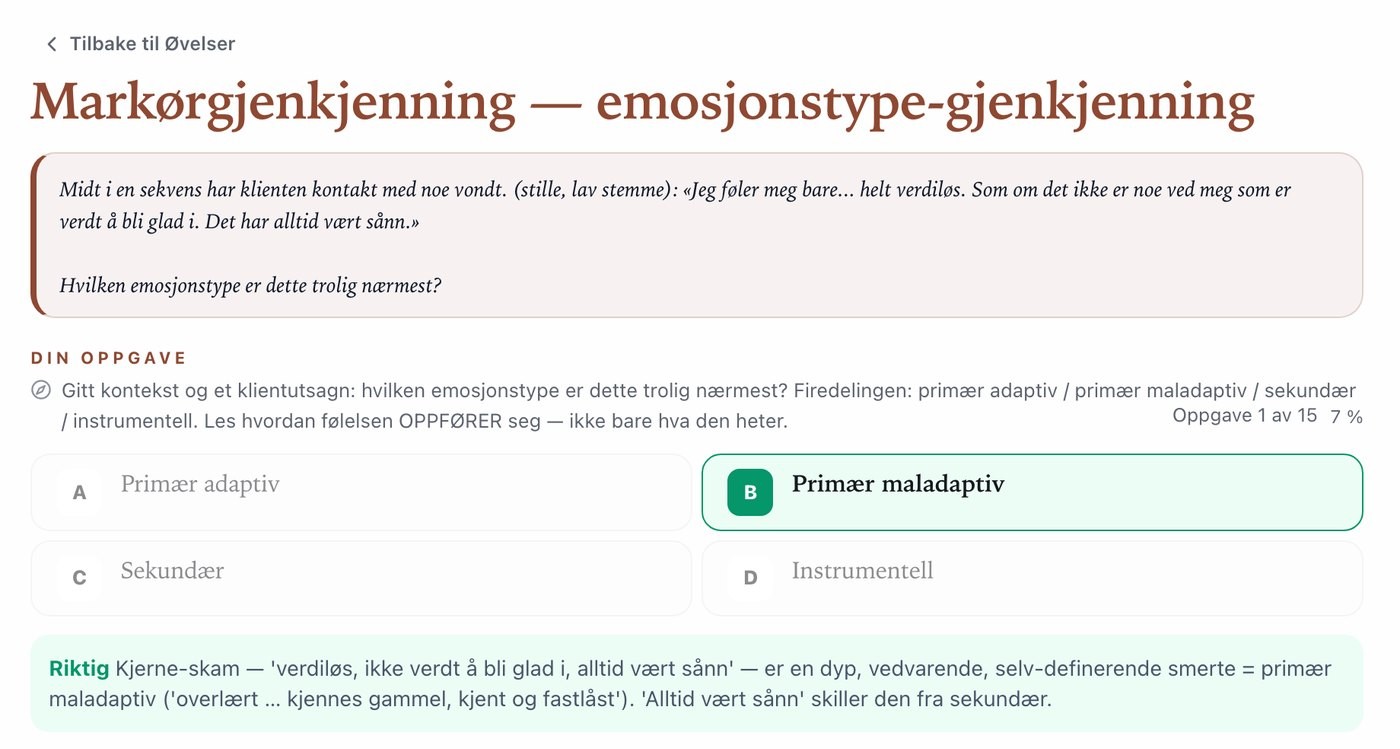
Before you can choose an intervention, you have to see what is happening. Short exercises train one component skill at a time: recognising the marker, distinguishing markers that look alike, choosing the intervention and phrasing the response yourself. After each answer you learn why.
“Test me” draws questions from across the lab, ungraded, and shows you what to practise next.

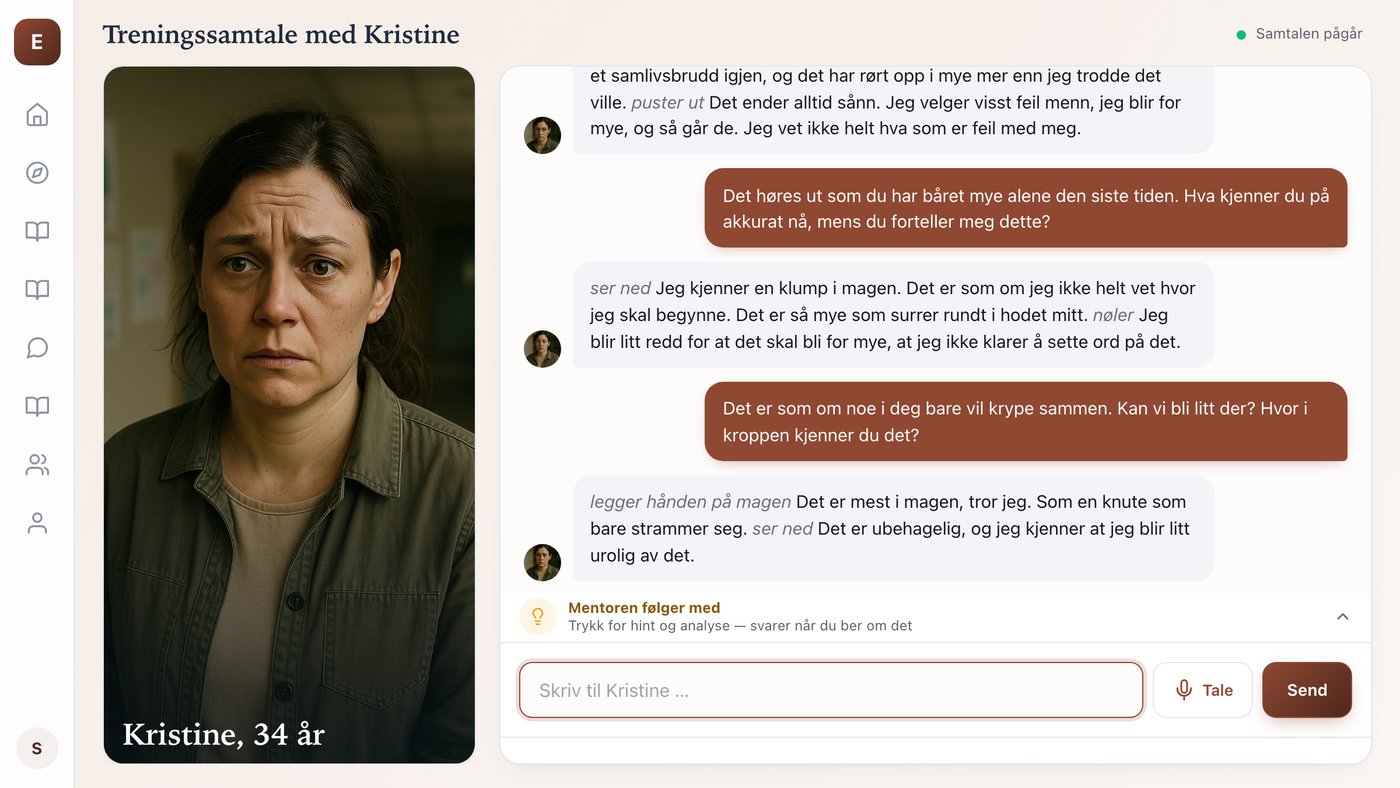
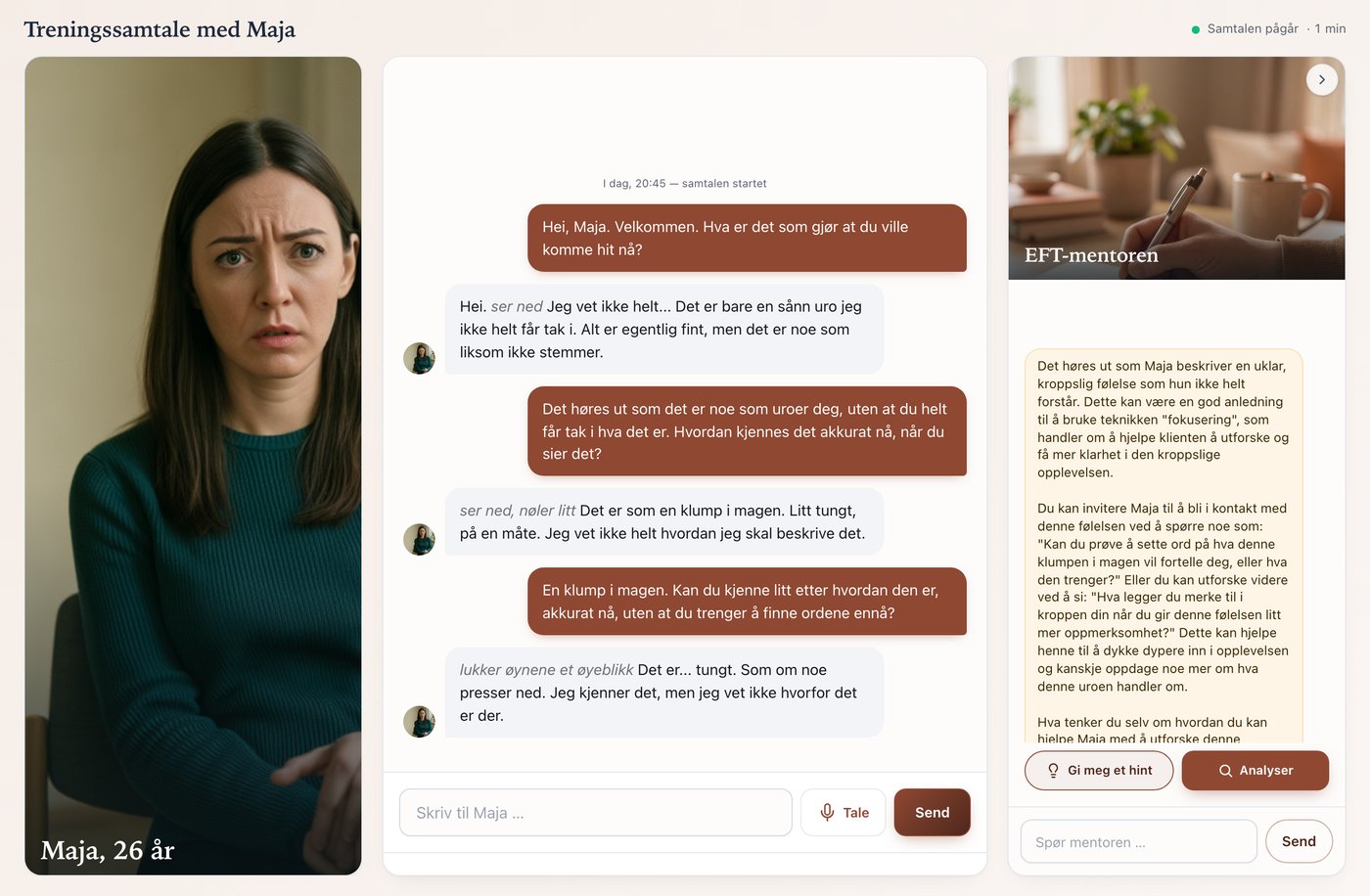
A short, contained session built around one intervention, with a client designed for exactly that moment. Therapists practise what feels hardest, at three levels of difficulty, as many times as they need.

Each client has a history and reactions of their own, and responds to what the therapist actually says, in text or by voice. The mentor follows along and offers a hint during the session, or an analysis of it, when the therapist asks.
The clients are fictional. The lab must never be used with information about real patients.

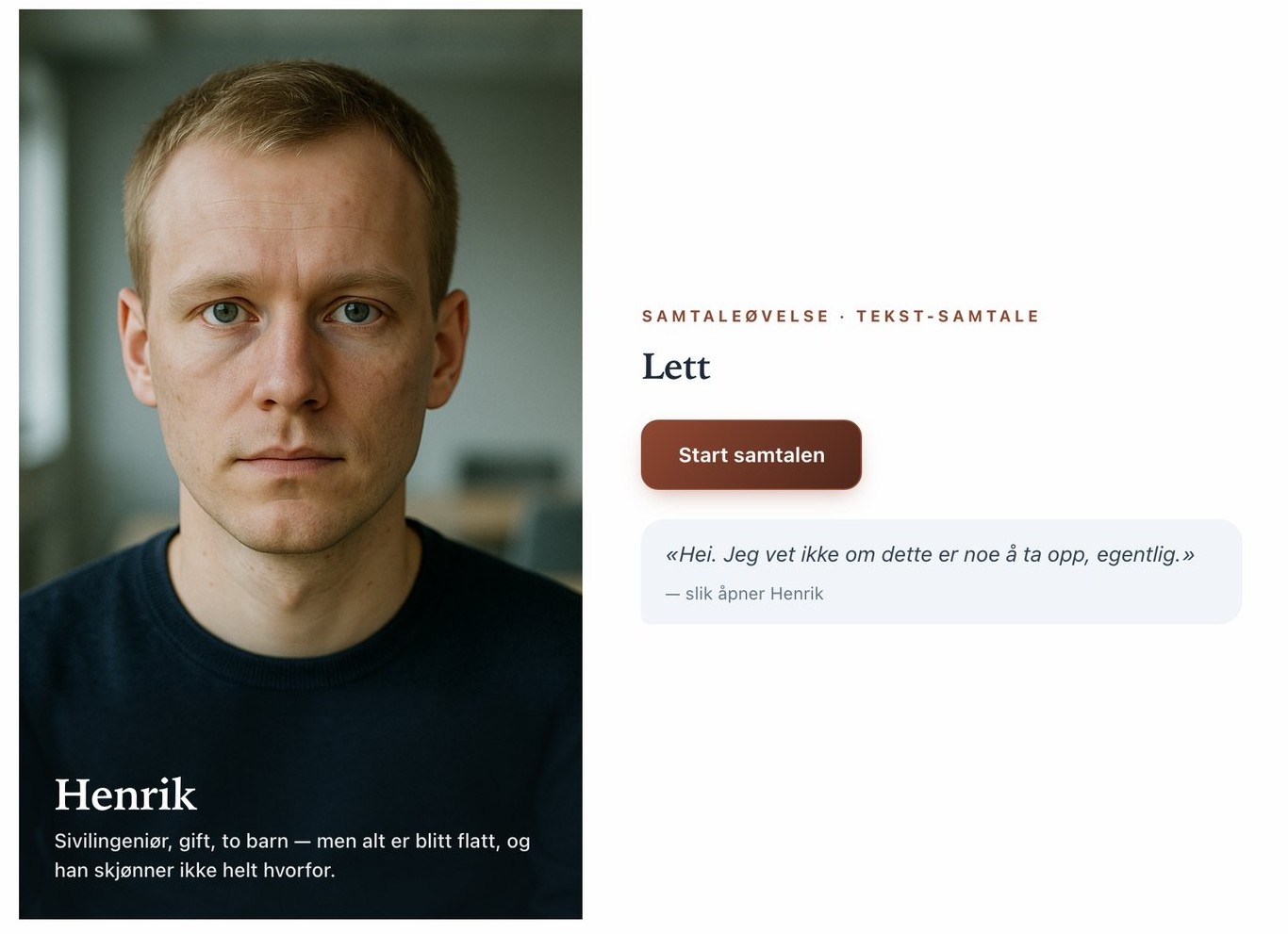
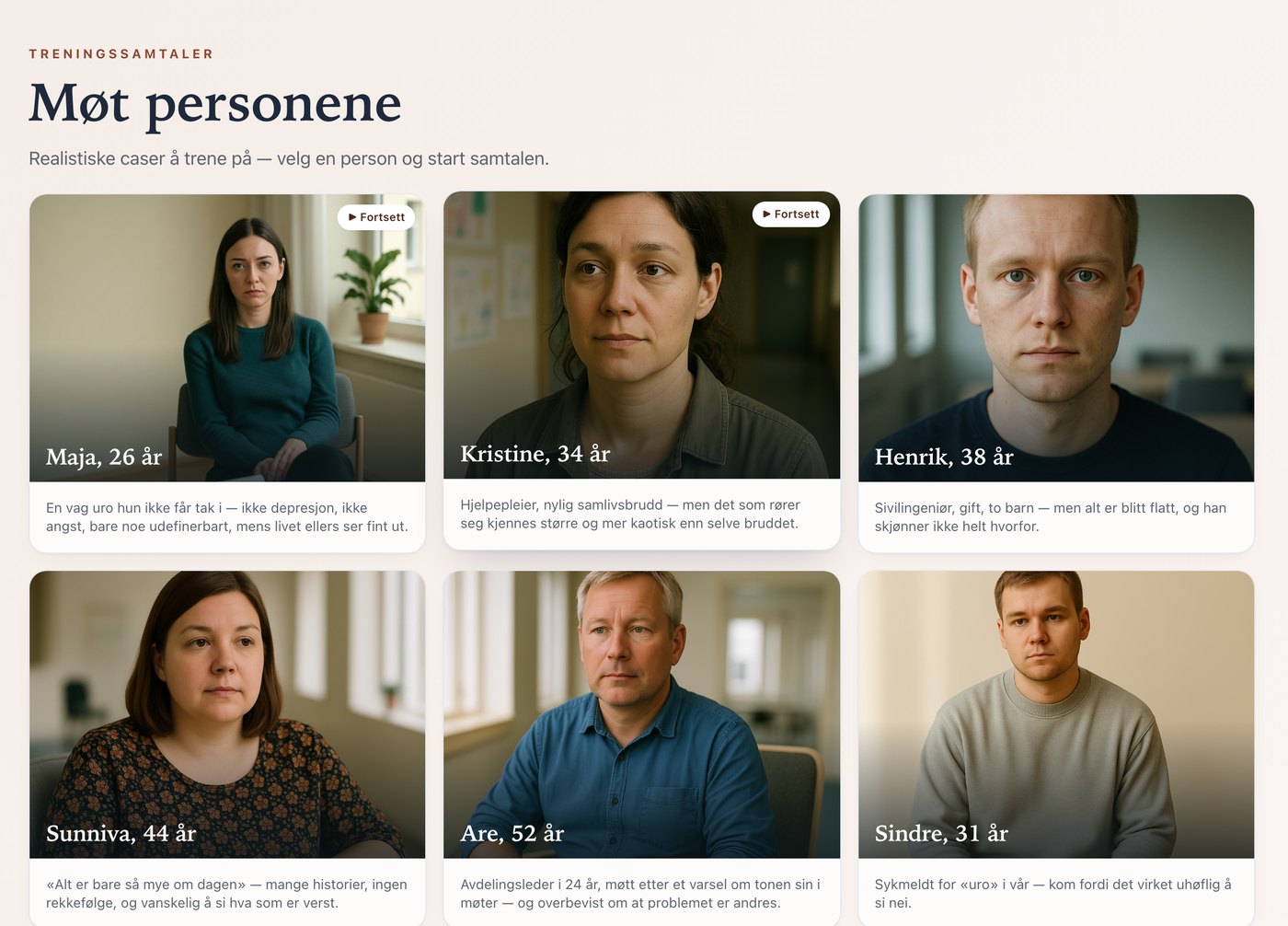
A gallery of clients of different ages, life circumstances and difficulties, created for the situations that matter in your approach. In the topic course on the self of the therapist, therapists also practise working with their own reactions. Those self-reflections are not stored, and neither we nor the trainer can see them.
Supervisors and trainers set up training groups with a share code, assign exercises before the next session, and use the lab between sessions and in supervision. The trainer cannot see the self-reflections.
The lab supplements supervision, teaching and clinical practice. It offers a safe place to practise specific skills, but it does not replace supervision, personal therapy or experience with real clients.
Therapists practise with AI-generated clients. Data is stored in Germany, and the content is not used to train AI models. Privacy policy (in Norwegian) →
We build the lab together with clinicians from your approach, from the first meeting until it is in use.
You and usThe interventions and markers that define the approach, and what is hardest to learn.
YouTheory, criteria and feedback build on the approach’s own concepts. Your trainers and clinicians approve the content.
Us, with therapistsWe create the clients, exercises and simulations. Therapists try them out, and we adjust until they ring true.
YouIn training, supervision or clinical settings, and it keeps developing as you learn.
The labs below do not exist yet. Each image shows how a focused simulation could look, with a client designed around the approach’s core skill. The illustrations are in Norwegian.
Illustration in Norwegian
Illustration in NorwegianWe build it together with you. Tell us which approach, and we will show you how a lab could be built.
Talk to Jan →Swipe for more examples →
Labs can be built in languages other than Norwegian and English. If you think a lab in your language would be useful in your setting, get in touch.
A translation is more than swapping words: the clinical content, the exercises and the simulated clients must be approved by someone who knows both the therapy and the language. That is the work we do together with you.

Schema therapy, ACT, family therapy, trauma therapy, or core therapist skills for a training programme. Jan Reidar Stiegler, specialist in clinical adult psychology, PhD, leads the psychotherapy work at DialogSkills and developed EFT-lab.
We would like to use Google Analytics to see how the site is used. It sets cookies. Read more (in Norwegian)